
Even though many women considering breast augmentation initially think in terms of “over” or “under” the muscle regarding breast implant placement, the reality is more nuanced. Experienced, board-certified plastic surgeons, including Dr. Jeffrey Rockmore, rely on refined techniques such as biplanar, subfascial, and submuscular placement to achieve the best possible results.
Why Placement Matters
Breast implant placement is one of the most important factors shaping your overall result. Where the implant sits in relation to the chest muscle directly influences how your breasts look, feel, and age over time.
From an aesthetic standpoint, placement determines the contour of the upper breast, the visibility of implant edges, and how naturally the implant blends with your existing tissue.
Placement and the type of implant—saline or silicone gel—affect how your breasts feel. Techniques that incorporate muscle coverage generally provide an added layer over the implant, which can make the result feel more like natural breast tissue. In contrast, implants placed entirely over the muscle may be firmer.
WARNING:
This feature contains nudity. Please click OK to confirm you are at least 18 years of age and are not offended by such material.

Implant Placement Options
Plastic surgeons create pockets during breast augmentation surgery where they place breast implants. Traditionally, the two options were behind the breast tissue but above the pectoral muscle (subglandular), or behind the muscle (submuscular). A dual-plane (biplanar) placement involves the implant sitting partially behind the muscle with the lower half behind the breast gland. Another option is subfascial placement, in which the implant is positioned above the muscle but beneath the fascia, a thin layer of connective tissue that covers the pectoral muscle.
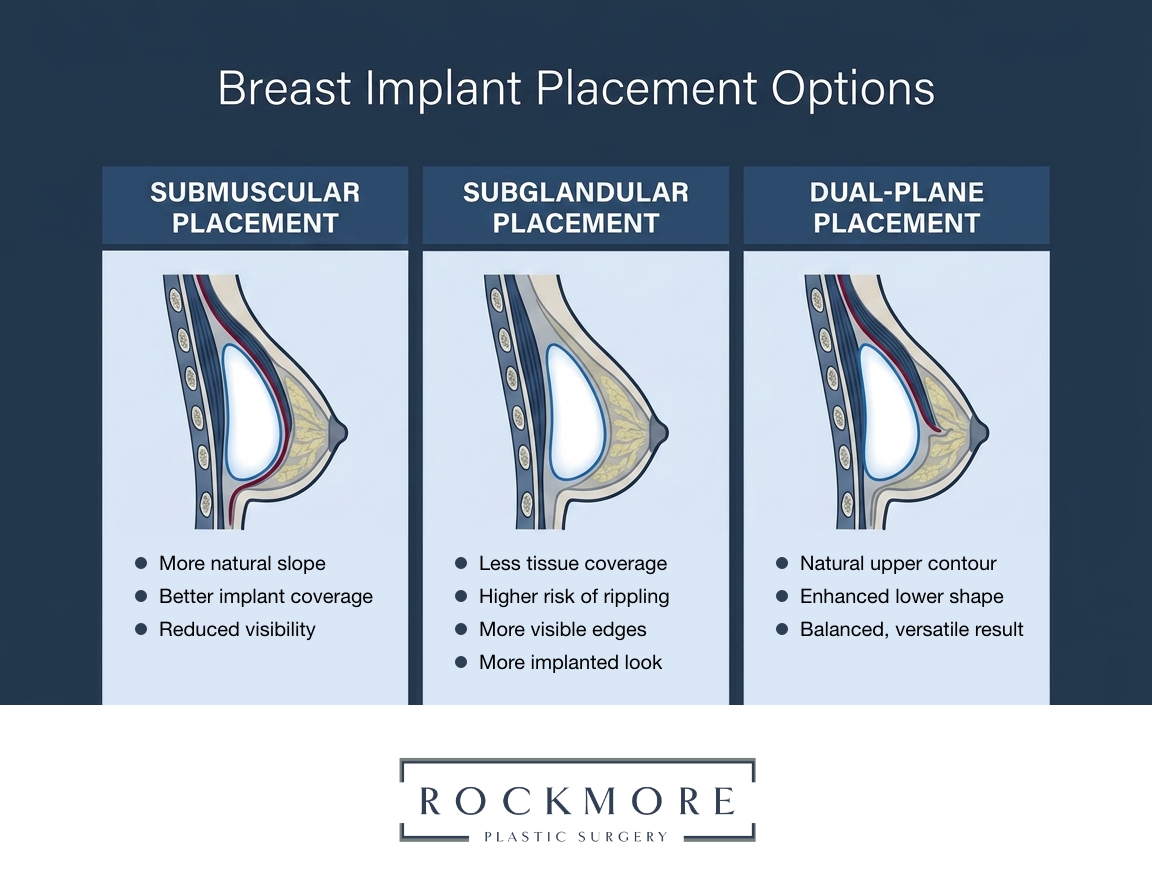
Let’s take a look at each option:
Submuscular (Under the Muscle)
For most women, submuscular placement results in a more natural breast slope and provides additional coverage of the implant. The technique requires more surgical precision and may involve a slightly longer recovery, but it offers several important advantages.
- More natural contour: The muscle provides additional coverage over the implant, creating a smoother transition from the chest to the breast.
- Reduced visibility of rippling: The added layer of tissue helps mask implant edges.
- Improved long-term aesthetics: Results tend to age more naturally as the implant is better supported.
- Better imaging outcomes: Implant placement under the muscle can improve mammogram accuracy.
For patients with thinner tissue or those seeking subtle, natural-looking enhancement, this approach is often the best choice.
Because the muscle is manipulated during the procedure, you may experience more initial soreness during recovery and temporary chest tightness. Still, most patients find these effects manageable and worth the aesthetic benefits.
Subglandular (Over the Muscle)
Subglandular placement involves positioning the implant directly behind the breast tissue without disturbing the chest muscle. This technique can offer a shorter recovery and less initial discomfort because the muscle is not manipulated.
It may also create a more pronounced, lifted look in certain patients, particularly those with sufficient natural breast tissue to cover the implant.
However, these benefits come with notable drawbacks, especially when long-term aesthetics are the priority.
The limitations of subglandular placement include:
- Higher risk of visible rippling: Without muscle coverage, implant edges can become more noticeable, particularly in thinner patients.
- Less natural look and feel: The implant sits closer to the skin, which can result in a less gradual, natural slope in the upper breast.
- Increased visibility of implant edges: This is particularly prevalent in patients with limited natural tissue.
- Potential for long-term tissue stretching: Placing an implant directly on the breast tissue can contribute to thinning over time, with less support for the implant
These reasons are why many surgeons reserve this approach for very specific cases rather than using it routinely.
Dual-Plane (Biplanar)
The dual-plane technique often used by Dr. Rockmore combines elements of both approaches. The upper portion of the implant is placed beneath the muscle, while the lower portion sits beneath the breast tissue.
This hybrid placement allows him to customize the result based on your anatomy. The advantages of biplanar placement include:
- Natural upper breast contour: Muscle coverage softens the transition and reduces visible edges.
- Improved lower breast shape: The implant can settle more naturally into the breast fold, which is useful when there is some sagging or when larger implants are considered.
- Lower risk of rippling in visible areas: This is especially true compared to over-the-muscle placement.
- Versatility: This technique works well for a wide range of body types and breast shapes.
Because it blends a natural-looking breast slope with natural movement, dual plane placement is widely considered one of the most refined and adaptable techniques available today.
Dr. Rockmore’s Approach
Dr. Rockmore focuses on techniques that produce natural-looking results and enhance long-term stability. Rather than defaulting to a one-size-fits-all method, he carefully evaluates:
- Your existing breast tissue
- Skin quality and thickness
- Chest anatomy
- Desired outcome
In virtually all cases, this leads to recommending submuscular or dual plane placement, where the implant is better supported and more seamlessly integrated with your natural anatomy.
During your consultation, Dr. Rockmore will guide you through these options, helping you understand not just the differences but how each approach will look and feel on your body.
Discuss Your Options With Dr. Rockmore
Breast augmentation involves several decisions, including the type and size of implants, incision location, and implant placement. Dr. Rockmore draws on his experience and expertise to guide your decision-making so you’ll be thrilled with the results. You can use the online form to request a consultation or call us at (518) 660-8641 to schedule an appointment.
Leave a Reply